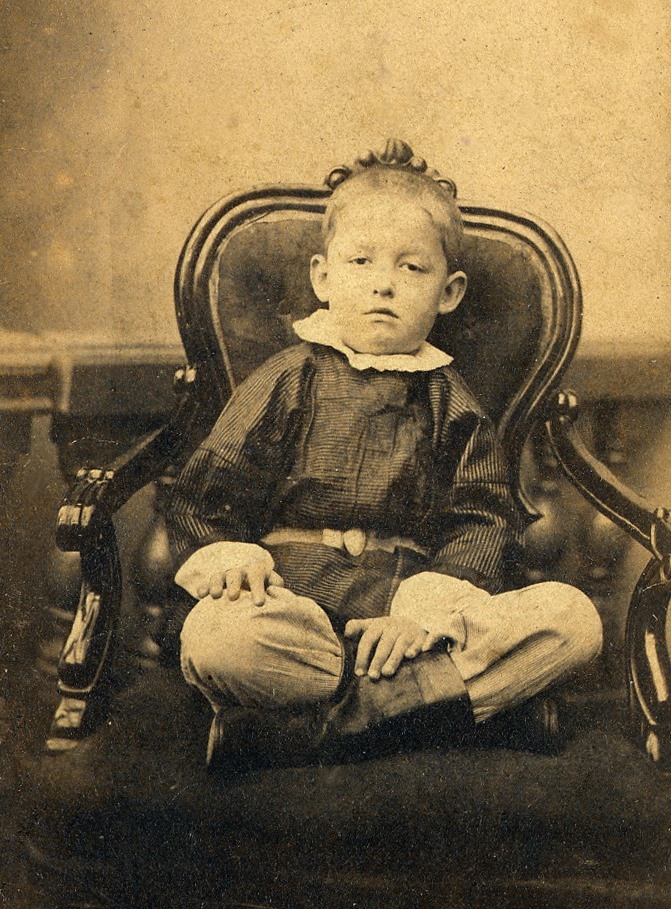
Studio portrait of Konstantin Tsiolkovsky as a child, age approximately 6–7, circa 1863–1864


Photobank tsiolkovsky.org
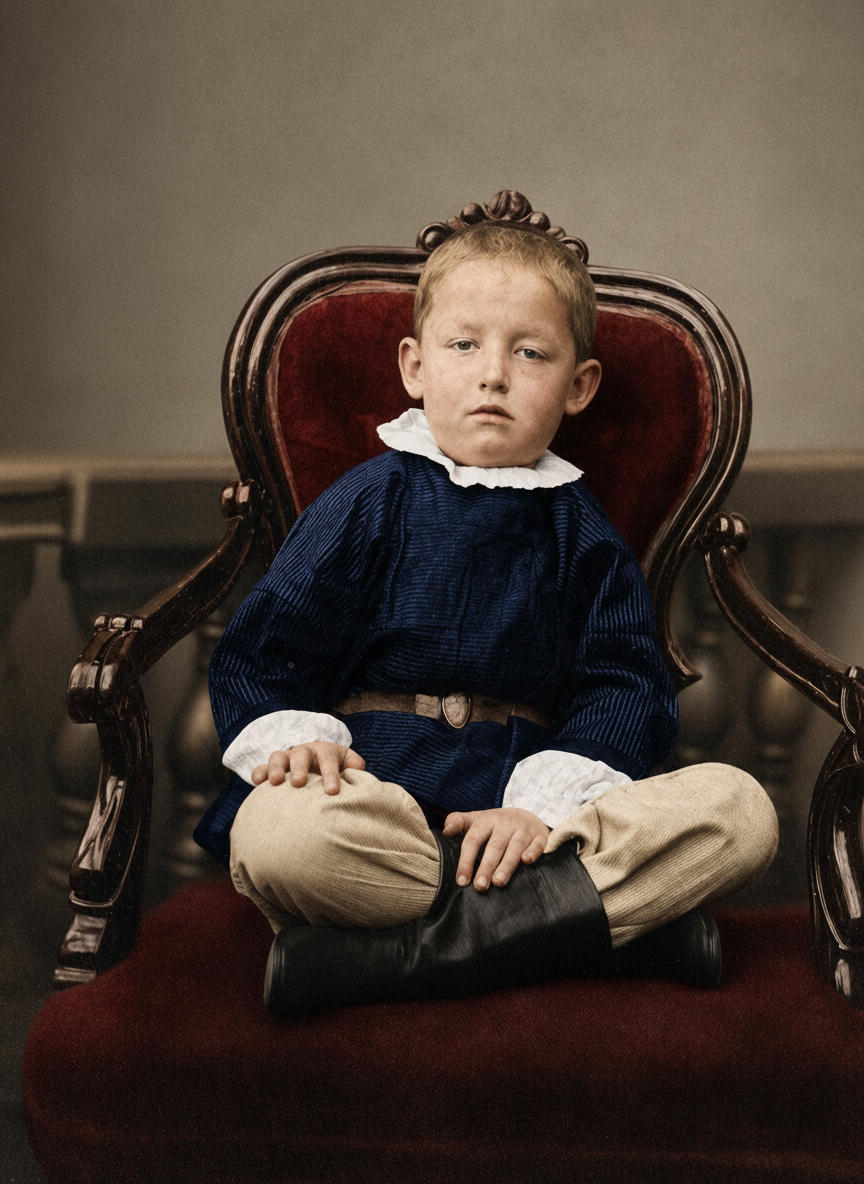

Studio portrait of Konstantin Tsiolkovsky as a child, age approximately 6–7, circa 1863–1864, Ryazan, Russian Empire. A restored, colorized, and artistically enhanced digital copy of an archival historical photograph from Wikimedia Commons (Public Domain). Digital restoration and colorization by Mykola Krasnostup.

Konstantin Tsiolkovsky as a child, age approximately 6–7,
circa 1863-1864, Ryazan, Russian Empire.

File ID: 039

Description: Studio portrait of Konstantin Tsiolkovsky as a child, age approximately 6–7, circa 1863–1864, Ryazan, Russian Empire.

Category: Restored, colorized, and artistically enhanced archival photograph from the public domain.

Source of digital copy of the original black-and-white photograph: Wikimedia Commons (Public Domain)

Digital restoration and colorization : Mykola Krasnostup


Configurator

Image parameters
Educational License
Commercial License
Free Version
JPG; sRGB; 75%;
864 x 1184 px (7.32 x 10.02 cm)
300 dpi
0.15 MB
Free x

Button to download a free image for educational purposes


Terms of Use


Educational License

“Educational License”

This Educational License (“License”) grants the Licensee a non-exclusive right to download the Image from the tsiolkovsky.org website free of charge and to use it solely for non-commercial purposes.

Licensee” means the individual or legal entity that downloaded the Image from the Website under the terms of the Educational License.

The “Image” refers to a historical photograph that has been digitally restored and colorized.

By clicking the “Download” button, the Licensee acknowledges that they have carefully read and agreed to the terms of the Educational License and agrees to abide by the following rules:


The Licensee has the right to:

  • Use the image for personal purposes;
  • Use the image in educational and research works (essays, term papers, theses, dissertations, and scientific publications);
  • Post the image in non-commercial web publications, including social media, blogs, and personal websites;
  • Use the image in educational presentations, lectures, school and museum projects;
  • Store the image on personal devices for the above purposes.


The Licensee has no right to:

  • Using the image for any commercial purposes, including advertising, product and service promotion, product design, paid publications, and revenue-generating projects;
  • Selling, transferring, or distributing the image file or copies thereof to third parties;
  • Publishing the image in paid media or books;
  • Using the image in illegal, offensive, defamatory, or misleading materials;
  • Using the image in logos, trademarks, or branding;
  • Removing or altering the file’s metadata.


Attribution

For each public use of the Image, the Licensee must indicate the following: “Original: Public Domain. Restoration and Colorization: Mykola Krasnostup (tsiolkovsky.org)


Intellectual Property

The original historical photograph is in the public domain. This License applies only to the restoration, enhancement, colorization, and creative processing performed by the Licensor.


Governing Law
This License shall be governed by applicable international copyright and intellectual property laws. The Licensee is solely responsible for ensuring that the image’s use (personality rights) is respected in their jurisdiction.

If you wish to use the image commercially, please purchase a Commercial License for additional benefits.


Thank you for following the Terms of Use!


FAQ


Information icon

Source file as a public domain work

Source of a digital copy of the original black and white photograph: Wikimedia Commons (Public Domain)

 Konstantin Eduardovich Tsiolkovsky as a child, age approximately 6–7, circa 1863–1864, Ryazan, Russian Empire. Source: Wikimedia Commons (Public Domain).. Public Domain icon

This work is in the public domain in its country of origin and other countries and areas where the copyright term is the author’s life plus 100 years or fewer.

Information iconFeatures of using AI tools in the restoration process

Features of using AI tools in the restoration process

During the restoration and colorization of digital copies of original black-and-white photographs, machine learning technologies and neural network algorithms were used exclusively as one of many image pre-processing tools for the following technical operations:

  • noise and artifact removal;
  • improving scan sharpness and quality;
  • upscaling (increasing resolution);
  • correction and restoration of some damaged areas (technical restoration);
  • basic rough colorization;
  • removal of dust, scratches, and stains;
  • increasing contrast and detail.

The restorer did NOT use machine learning technologies or neural network algorithms for the following technical operations:

  • to modify the face, expression, facial expressions, or anatomy;
  • to generate the background;
  • to recreate lost fragments without manual rework.

The final result is the artistic work of the restorer, who:

  • manually processed the colors;
  • manually corrected the details;
  • manually processed the face and key elements. Minor distortions of small details are possible.

For reference:

AI (artificial intelligence) is a field of computer science that focuses on creating systems and programs capable of performing tasks that require human intelligence.

An AI tool is any application, program, or service that uses artificial intelligence systems to perform tasks faster, more accurately, or more conveniently than conventional tools.

Information icon

Features of colorization of an image that was originally black and white

Colorization is the process of adding color to an image that was originally black and white or colorless.

Colorization makes old historical photographs more realistic and vibrant. However, the colors of objects in black and white photographs cannot be restored with 100% accuracy. We conducted historical and visual research of the materials and colors of all objects in the restored photographs with the goal of proposing historically based materials and colors for colorization. The research was conducted according to the principle of “first direct sources, then contextual analogs, and then careful visual reconstruction.” For each object in the photographs, we checked whether there was a direct description in any sources. If no direct information about the material or color was found, the most probable variant was chosen, consistent with the visible tone in the photograph, the general clothing practices of the time, and the characteristics of old prints. Accordingly, although the process of colorizing the original black-and-white image is carried out based on the historical context, the result is the restorer’s artistic interpretation and does not claim complete historical accuracy of the color scheme.

Information icon

How to obtain an image for non-commercial use?

Click the Download button and download a free ZIP archive containing the image, complete with an “Educational License”.


Keywords:

Tsiolkovsky, Tsiolkovski, Ziolkowski, Ciołkowski, Tsiolkovskiy, Tsiolkovskii, Tziolkowsky, Ciolkowsky, Public Domain, Commercial license, Educational license, Royalty-free, historical photo, photobank, photostock, restoration, colorization, digital product, download for free, free download,



book2

Do you want to get acquainted with the results of Konstantin Eduardovich Tsiolkovsky’s research?

In the “Scientific Heritage” section of the site you can read some articles by Konstantin Eduardovich Tsiolkovsky translated into English and download them in PDF format for free.

In the “Научное наследие” section of the site you can read most of Konstantin Eduardovich Tsiolkovsky’s works in original Russian and download them for free in PDF format.


Enjoy reading!


Photographs of Konstantin Tsiolkovsky

[pdf width=”80%” height=”900px”]https://www.tsiolkovsky.org/wp-content/uploads/2019/09/Pictures_en.pdf[/pdf]

***


Photograph prints of Konstantin Tsiolkovsky as a child
A portrait photograph of Konstantin Tsiolkovsky taken when he worked as a teacher in Kaluga diocesan girls’ school.
A portrait photograph of Konstantin Tsiolkovsky
Photographs of Konstantin Tsiolkovsky with scale models of his airships
A portrait photograph of Konstantin Tsiolkovsky
Photographs of Konstantin Tsiolkovsky working in his room
A photograph of Konstantin Tsiolkovsky beside a turning lathe in his own workshop
Photographs of Konstantin Tsiolkovsky with his acoustic tube
Photographs of Konstantin Tsiolkovsky having a rest in his backyard
Portrait photographs of Konstantin Tsiolkovsky
Photographs of Konstantin Tsiolkovsky
Photographs of Konstantin Tsiolkovsky having a bicycle ride in the country
A portrait photograph of Konstantin Tsiolkovsky
A photograph of Konstantin Tsiolkovsky taking a siesta
A photograph of Konstantin Tsiolkovsky with an inscription to Alexander Chizhevsky
etc.

“Citizens of the Universe”


“Citizens of the Universe”, Konstantin Tsiolkovsky, 1933


Here we would like to begin from the beginning, i.e., from elements of the Universe. Who is an immortal citizen of space? It is its atom. An atom – not the one known in science, but a true one – an indivisible particle, matter. Is there any of such? Hardly so. Let’s refer to scientific facts. All so-called atoms (92 items) are composed of hydrogen. Hydrogen itself is complex. But there is also aether. It consists of extremely small particles. It is possible that all matter, i.e. all other atoms, consists of them.

 A true atom is unknown. One thing is observed: the simpler the atom, the more difficult its disintegration is. The most massive atoms decay in thousands of years and even less. Less massive ones – in billions of years. Even more common – in billions, trillions and decillions of years. Particles of hydrogen and aether may be of this kind.

 Matter is a carrier of sense, since there is nothing but matter. What then we can attribute a feeling to? Where the matter is, where the atom is, there is a feeling. Atom or a part of it can be called primal (primitive), or simple, spirit, but, as we have seen, each atom is a composition of the simplest. Destiny of an unknown simplest one depends on participation of the atoms known to science.*

 There are as many true atoms, as there are primal spirits. A primal spirit wanders through the universe and forms unions. We recognize only unions in the world. Life and feeling of an atom depends on the complexity of the union, which it is in: the more complex the union is, the more complex the activity and feeling of the atom. Here is a rough representation of gradually increasing complexity of an atom’s life.

 ……………………………………………………         (beginning unknown).

  1. Life in a particle of ether. Existence for decillions of years, and then disintegration into simpler particles or entering into a combination of more complex ones.   ……………………………………………………     (gap of unknown length).
  2. Existence for trillions of years in a hydrogen particle, and then – disintegration or entering a more complex structure.
  3.  Being in 92 atoms of known elements, then – disintegration or complication.
  4.  Life in plants and lower animals.
  5.  Life in human and higher creatures.

 A single “self”, or a single spirit, exists only in an unknown primitive atom. All other known particles contain the more spirits, the more complicated the particle is. Only unions of spirits are known to us. Even particles of aether are unions of spirits. But this union is very stable, almost indestructible, because lasts for decillions of years. A great number of spirits in it, possibly, feel concordantly. The word ‘feeling’ has only mathematical value here, like a speck of dust, which we do not weigh, do not measure and do not consider its mass. This is a conditional nonexistence. Only in higher animals spirits experience what we conditionally name life, or being.

 A man or an even higher combination reflects the Universe not fully, but correctly. Such a combination of spirits is a very complex alliance of spirits under single control. But this combination, as the most passive one, is the least stable. However, duration of this stability can grow considerably. It is indeterminate and to a large extent depends on the mechanism of the union. Like life of a republic or its stability depends on the laws of the country, and timespan of an animal’s existence – on perfection of its organization. There can be such an organization of a country that it not only will preserve itself but also will prevail against all others organized otherwise. In the same way, a successful animal can become a prevailing type.

 Let us – conventionally – name a primitive spirit ‘aether’. What is its destiny? It roams all over the Universe and whatever its state, the same is state of an atom. Whatever destiny of one atom is, the same is destiny of all.

 So, to know destiny of an atom, we must know destiny of the Universe. It also is reflected in higher human creatures and that is why is known to them.

 It is science with its conclusions, that is a reflection of space. Intellect and feelings are the source of science.

 Every mature mind says the same: if there will be no evil, sorrow, imperfection, ignorance, weakness and insanity in the Universe, it will be good for an atom as well.

 The conclusion from the above-mentioned is the following: everything which is bad, causes suffering or multiplies insanity must be eliminated from the Universe. But eliminated without cruelty to anything being destroyed. How to do it? Very easily – reproduction of the imperfect should be stopped. There are many methods to achieve it.

 Alternatively, it is necessary to focus all forces of intelligent higher creatures on facilitating reproduction of everything perfect. Let the world be filled by it – as quickly as possible – and let the intellect, which brings happiness and annihilates sorrow, dominate in the world.

* Destiny of an unknown simplest one depends on participation of the atoms known to science. (Rus – Участь неизвестного простейшего зависит от участия известных науке атомов.)

Translator’s note: There are grounds for believing that there might be a typo in one word of the original Russian phrase which changes its meaning considerably. If it is so, the phrase is “Участь неизвестного простейшего зависит от участи известных науке атомов” and its English translation is the following: Destiny of an unknown simplest one depends on destiny of the atoms known to science.


book2You have read the article by Konstantin Tsiolkovsky.

You can download it for free in PDF format from the “The Collection of Works” section of the website. Unfortunately, most of Konstantin Tsiolkovsky’s works have not been translated into English. You can familiarize yourself with the works in Russian from the “Научное наследие” (“Scientific heritage”) section of the website.

Enjoy the reading!