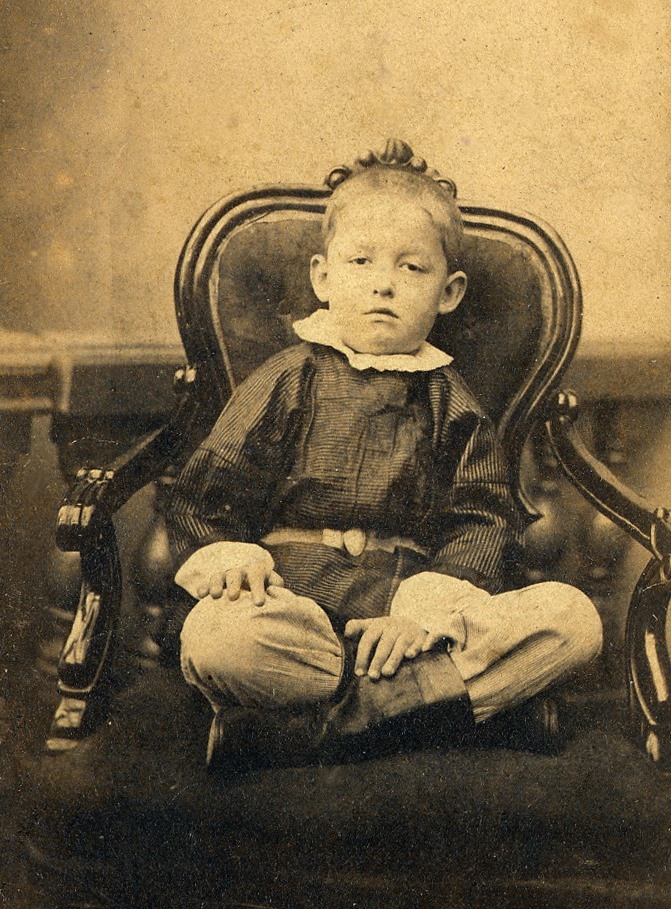
Studio portrait of Konstantin Tsiolkovsky as a child, age approximately 6–7, circa 1863–1864


Photobank tsiolkovsky.org
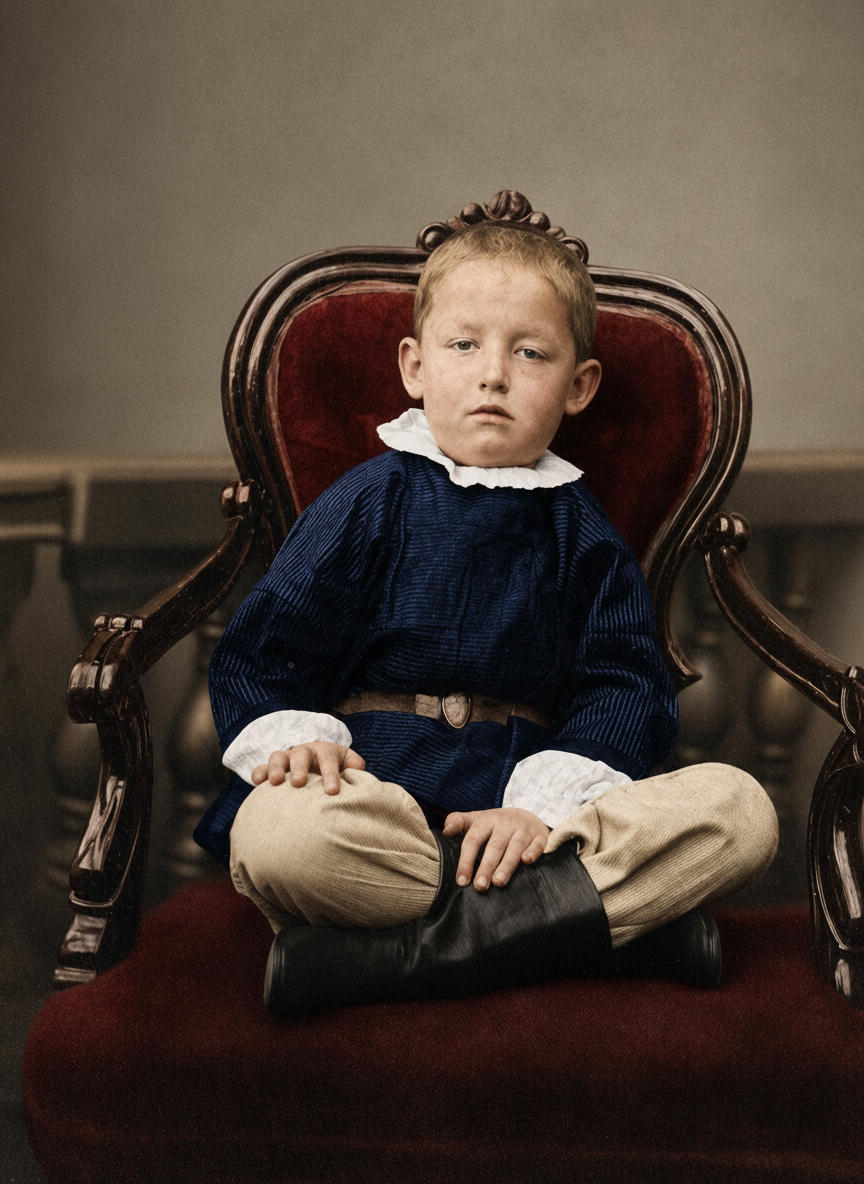

Studio portrait of Konstantin Tsiolkovsky as a child, age approximately 6–7, circa 1863–1864, Ryazan, Russian Empire. A restored, colorized, and artistically enhanced digital copy of an archival historical photograph from Wikimedia Commons (Public Domain). Digital restoration and colorization by Mykola Krasnostup.

Konstantin Tsiolkovsky as a child, age approximately 6–7,
circa 1863-1864, Ryazan, Russian Empire.

File ID: 039

Description: Studio portrait of Konstantin Tsiolkovsky as a child, age approximately 6–7, circa 1863–1864, Ryazan, Russian Empire.

Category: Restored, colorized, and artistically enhanced archival photograph from the public domain.

Source of digital copy of the original black-and-white photograph: Wikimedia Commons (Public Domain)

Digital restoration and colorization : Mykola Krasnostup


Configurator

Image parameters
Educational License
Commercial License
Free Version
JPG; sRGB; 75%;
864 x 1184 px (7.32 x 10.02 cm)
300 dpi
0.15 MB
Free x

Button to download a free image for educational purposes


Terms of Use


Educational License

“Educational License”

This Educational License (“License”) grants the Licensee a non-exclusive right to download the Image from the tsiolkovsky.org website free of charge and to use it solely for non-commercial purposes.

Licensee” means the individual or legal entity that downloaded the Image from the Website under the terms of the Educational License.

The “Image” refers to a historical photograph that has been digitally restored and colorized.

By clicking the “Download” button, the Licensee acknowledges that they have carefully read and agreed to the terms of the Educational License and agrees to abide by the following rules:


The Licensee has the right to:

  • Use the image for personal purposes;
  • Use the image in educational and research works (essays, term papers, theses, dissertations, and scientific publications);
  • Post the image in non-commercial web publications, including social media, blogs, and personal websites;
  • Use the image in educational presentations, lectures, school and museum projects;
  • Store the image on personal devices for the above purposes.


The Licensee has no right to:

  • Using the image for any commercial purposes, including advertising, product and service promotion, product design, paid publications, and revenue-generating projects;
  • Selling, transferring, or distributing the image file or copies thereof to third parties;
  • Publishing the image in paid media or books;
  • Using the image in illegal, offensive, defamatory, or misleading materials;
  • Using the image in logos, trademarks, or branding;
  • Removing or altering the file’s metadata.


Attribution

For each public use of the Image, the Licensee must indicate the following: “Original: Public Domain. Restoration and Colorization: Mykola Krasnostup (tsiolkovsky.org)


Intellectual Property

The original historical photograph is in the public domain. This License applies only to the restoration, enhancement, colorization, and creative processing performed by the Licensor.


Governing Law
This License shall be governed by applicable international copyright and intellectual property laws. The Licensee is solely responsible for ensuring that the image’s use (personality rights) is respected in their jurisdiction.

If you wish to use the image commercially, please purchase a Commercial License for additional benefits.


Thank you for following the Terms of Use!


FAQ


Information icon

Source file as a public domain work

Source of a digital copy of the original black and white photograph: Wikimedia Commons (Public Domain)

 Konstantin Eduardovich Tsiolkovsky as a child, age approximately 6–7, circa 1863–1864, Ryazan, Russian Empire. Source: Wikimedia Commons (Public Domain).. Public Domain icon

This work is in the public domain in its country of origin and other countries and areas where the copyright term is the author’s life plus 100 years or fewer.

Information iconFeatures of using AI tools in the restoration process

Features of using AI tools in the restoration process

During the restoration and colorization of digital copies of original black-and-white photographs, machine learning technologies and neural network algorithms were used exclusively as one of many image pre-processing tools for the following technical operations:

  • noise and artifact removal;
  • improving scan sharpness and quality;
  • upscaling (increasing resolution);
  • correction and restoration of some damaged areas (technical restoration);
  • basic rough colorization;
  • removal of dust, scratches, and stains;
  • increasing contrast and detail.

The restorer did NOT use machine learning technologies or neural network algorithms for the following technical operations:

  • to modify the face, expression, facial expressions, or anatomy;
  • to generate the background;
  • to recreate lost fragments without manual rework.

The final result is the artistic work of the restorer, who:

  • manually processed the colors;
  • manually corrected the details;
  • manually processed the face and key elements. Minor distortions of small details are possible.

For reference:

AI (artificial intelligence) is a field of computer science that focuses on creating systems and programs capable of performing tasks that require human intelligence.

An AI tool is any application, program, or service that uses artificial intelligence systems to perform tasks faster, more accurately, or more conveniently than conventional tools.

Information icon

Features of colorization of an image that was originally black and white

Colorization is the process of adding color to an image that was originally black and white or colorless.

Colorization makes old historical photographs more realistic and vibrant. However, the colors of objects in black and white photographs cannot be restored with 100% accuracy. We conducted historical and visual research of the materials and colors of all objects in the restored photographs with the goal of proposing historically based materials and colors for colorization. The research was conducted according to the principle of “first direct sources, then contextual analogs, and then careful visual reconstruction.” For each object in the photographs, we checked whether there was a direct description in any sources. If no direct information about the material or color was found, the most probable variant was chosen, consistent with the visible tone in the photograph, the general clothing practices of the time, and the characteristics of old prints. Accordingly, although the process of colorizing the original black-and-white image is carried out based on the historical context, the result is the restorer’s artistic interpretation and does not claim complete historical accuracy of the color scheme.

Information icon

How to obtain an image for non-commercial use?

Click the Download button and download a free ZIP archive containing the image, complete with an “Educational License”.


Keywords:

Tsiolkovsky, Tsiolkovski, Ziolkowski, Ciołkowski, Tsiolkovskiy, Tsiolkovskii, Tziolkowsky, Ciolkowsky, Public Domain, Commercial license, Educational license, Royalty-free, historical photo, photobank, photostock, restoration, colorization, digital product, download for free, free download,



book2

Do you want to get acquainted with the results of Konstantin Eduardovich Tsiolkovsky’s research?

In the “Scientific Heritage” section of the site you can read some articles by Konstantin Eduardovich Tsiolkovsky translated into English and download them in PDF format for free.

In the “Научное наследие” section of the site you can read most of Konstantin Eduardovich Tsiolkovsky’s works in original Russian and download them for free in PDF format.


Enjoy reading!
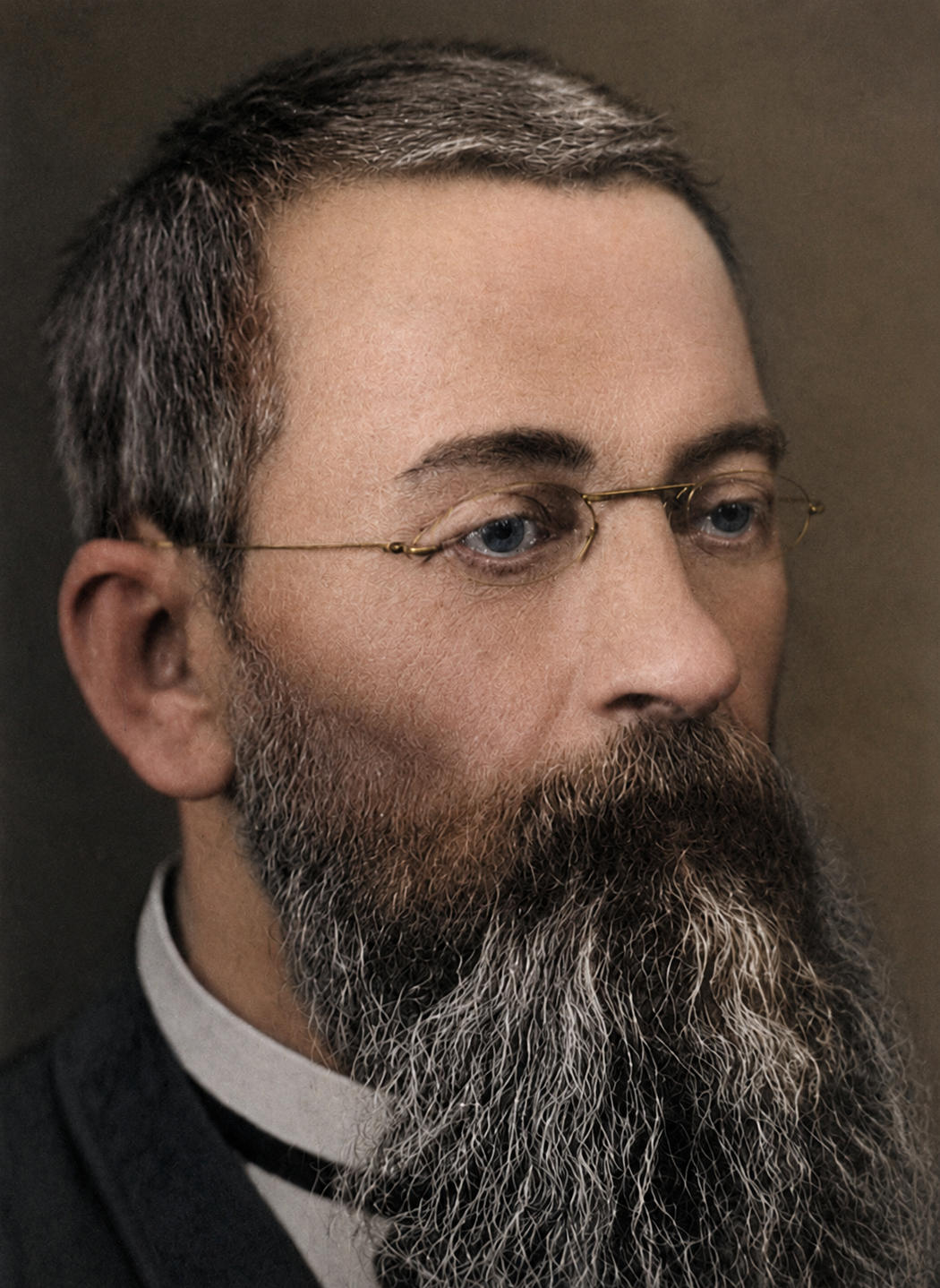


Tsiolkovsky Eduard Ignatyevich (1820–1881), father of Konstantin Eduardovich Tsiolkovsky


Photobank tsiolkovsky.org


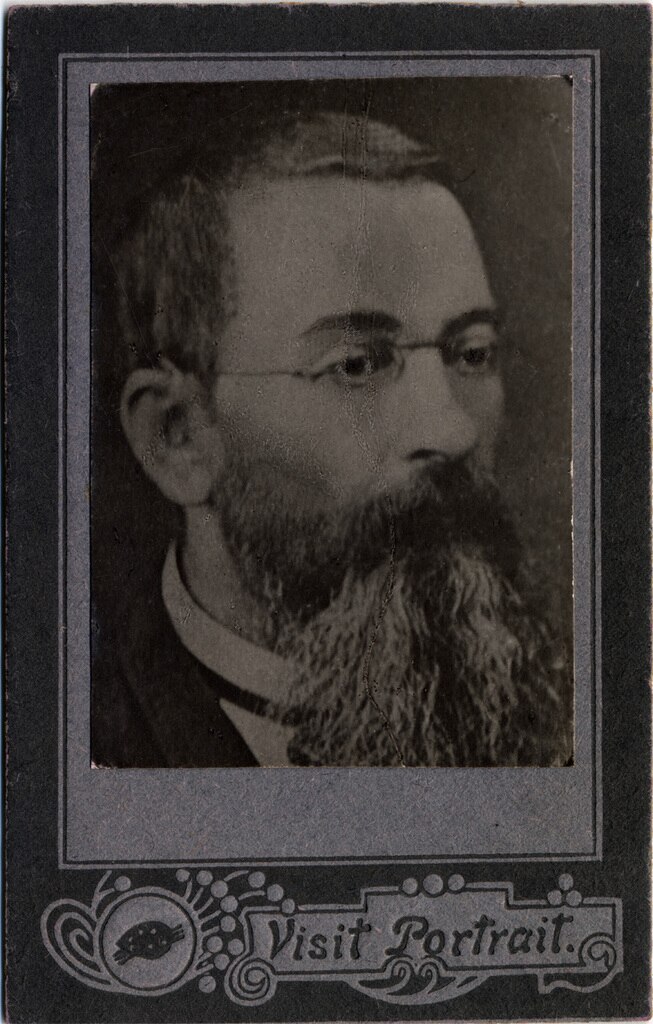
Tsiolkovsky Eduard Ignatyevich (1820–1881) — father of Konstantin Eduardovich Tsiolkovsky, circa 1862-1863. Ryazan, Russian Empire. A restored, colorized, and artistically enhanced digital copy of an archival historical photograph from Wikimedia Commons (Public Domain). Digital restoration and colorization by Mykola Krasnostup.

Tsiolkovsky Eduard Ignatyevich (1820-1881),
father of Konstantin Eduardovich Tsiolkovsky

File ID: 086

Description: Tsiolkovsky Eduard Ignatyevich (1820–1881) (1824-1870), father of K. E. Tsiolkovsky. Ryazan, Russian Empire.

Category: Restored, colorized, and artistically enhanced archival photograph from the public domain..

Source of digital copy of the original black-and-white photograph: Wikimedia Commons (Public Domain)

Digital restoration and colorization : Mykola Krasnostup


Configurator

Image parameters
Educational License
Commercial License
Free Version
JPG; sRGB; 75%;
1050 x 1438 px (8.89 × 12.17 cm)
300 dpi
0.22 Mб
Free x

Button to download a free image for educational purposes


Terms of Use


Educational License

“Educational License”

This Educational License (“License”) grants the Licensee a non-exclusive right to download the Image from the tsiolkovsky.org website free of charge and to use it solely for non-commercial purposes.

Licensee” means the individual or legal entity that downloaded the Image from the Website under the terms of the Educational License.

The “Image” refers to a historical photograph that has been digitally restored and colorized.

By clicking the “Download” button, the Licensee acknowledges that they have carefully read and agreed to the terms of the Educational License and agrees to abide by the following rules:


The Licensee has the right to:

  • Use the image for personal purposes;
  • Use the image in educational and research works (essays, term papers, theses, dissertations, and scientific publications);
  • Post the image in non-commercial web publications, including social media, blogs, and personal websites;
  • Use the image in educational presentations, lectures, school and museum projects;
  • Store the image on personal devices for the above purposes.


The Licensee has no right to:

  • Using the image for any commercial purposes, including advertising, product and service promotion, product design, paid publications, and revenue-generating projects;
  • Selling, transferring, or distributing the image file or copies thereof to third parties;
  • Publishing the image in paid media or books;
  • Using the image in illegal, offensive, defamatory, or misleading materials;
  • Using the image in logos, trademarks, or branding;
  • Removing or altering the file’s metadata.


Attribution

For each public use of the Image, the Licensee must indicate the following: “Original: Public Domain. Restoration and Colorization: Mykola Krasnostup (tsiolkovsky.org)


Intellectual Property

The original historical photograph is in the public domain. This License applies only to the restoration, enhancement, colorization, and creative processing performed by the Licensor.


Governing Law
This License shall be governed by applicable international copyright and intellectual property laws. The Licensee is solely responsible for ensuring that the image’s use (personality rights) is respected in their jurisdiction.

If you wish to use the image commercially, please purchase a Commercial License for additional benefits.


Thank you for following the Terms of Use!


FAQ


Information icon

Source file as a public domain work

Source of a digital copy of the original black and white photograph: Wikimedia Commons (Public Domain)

Tsiolkovsky Eduard Ignatyevich (1820–1881) — father of Konstantin Eduardovich Tsiolkovsky, circa 1862-1863. Ryazan, Russian Empire. Source: Public Domain. Public Domain icon

This work was published on territory of the Russian Empire (Russian Republic) except for territories of the Grand Duchy of Finland and Congress Poland before 7 November 1917 and wasn’t re-published for 30 days following initial publications on the territory of Soviet Russia or any other countries.

The Russian Federation (early Soviet Russia, RSFSR) is the historical heir but not legal successor of the Russian Empire, and the Russian Empire was not party to the Berne Convention (it was not country of Union for the protection of the rights of authors in their literary and artistic works), so according to article 5 of the Convention this work has no country of origin except:

  • in the case of cinematographic work the maker of which has his headquarters or his habitual residence in a country of the Union, the country of origin shall be that country,
  • in the case of architecture erected in a country of the Union or other artistic works incorporated in a building or other structure located in a country of the Union, the country of origin shall be that country,
  • in the case of other works if the author is a national of a country of the Union¹, the country of origin shall be that country.

¹ – Author who is not a national of a country of the Union but who has his habitual residence in a country of the Union, be assimilated to national of that country.

This work is in the public domain in the United States because it was published (or registered with the U.S. Copyright Office) before January 1, 1931.

Information iconFeatures of using AI tools in the restoration process

Features of using AI tools in the restoration process

During the restoration and colorization of digital copies of original black-and-white photographs, machine learning technologies and neural network algorithms were used exclusively as one of many image pre-processing tools for the following technical operations:

  • noise and artifact removal;
  • improving scan sharpness and quality;
  • upscaling (increasing resolution);
  • correction and restoration of some damaged areas (technical restoration);
  • basic rough colorization;
  • removal of dust, scratches, and stains;
  • increasing contrast and detail.

The restorer did NOT use machine learning technologies or neural network algorithms for the following technical operations:

  • to modify the face, expression, facial expressions, or anatomy;
  • to generate the background;
  • to recreate lost fragments without manual rework.

The final result is the artistic work of the restorer, who:

  • manually processed the colors;
  • manually corrected the details;
  • manually processed the face and key elements. Minor distortions of small details are possible.

For reference:

AI (artificial intelligence) is a field of computer science that focuses on creating systems and programs capable of performing tasks that require human intelligence.

An AI tool is any application, program, or service that uses artificial intelligence systems to perform tasks faster, more accurately, or more conveniently than conventional tools.

Information icon

Features of colorization of an image that was originally black and white

Colorization is the process of adding color to an image that was originally black and white or colorless.

Colorization makes old historical photographs more realistic and vibrant. However, the colors of objects in black and white photographs cannot be restored with 100% accuracy. We conducted historical and visual research of the materials and colors of all objects in the restored photographs with the goal of proposing historically based materials and colors for colorization. The research was conducted according to the principle of “first direct sources, then contextual analogs, and then careful visual reconstruction.” For each object in the photographs, we checked whether there was a direct description in any sources. If no direct information about the material or color was found, the most probable variant was chosen, consistent with the visible tone in the photograph, the general clothing practices of the time, and the characteristics of old prints. Accordingly, although the process of colorizing the original black-and-white image is carried out based on the historical context, the result is the restorer’s artistic interpretation and does not claim complete historical accuracy of the color scheme.

Information icon

How to obtain an image for non-commercial use?

Click the Download button and download a free ZIP archive containing the image, complete with an “Educational License”.


Keywords:

Tsiolkovsky Eduard Ignatyevich , father of Konstantin Eduardovich Tsiolkovsky, father of Konstantin Tsiolkovsky, father of Tsiolkovsky, Tsiolkovsky, Tsiolkovski, Ziolkowski, Ciołkowski, Tsiolkovskiy, Tsiolkovskii, Tziolkowsky, Ciolkowsky, Public Domain, Commercial license, Educational license, Royalty-free, historical photo, photobank, photostock, restoration, colorization, digital product, download for free, free download,


book2

Do you want to get acquainted with the results of Konstantin Eduardovich Tsiolkovsky’s research?

In the “Scientific Heritage” section of the site you can read some articles by Konstantin Eduardovich Tsiolkovsky translated into English and download them in PDF format for free.

In the “Научное наследие” section of the site you can read most of Konstantin Eduardovich Tsiolkovsky’s works in original Russian and download them for free in PDF format.


Enjoy reading!


Tsiolkovskaya (Yumasheva) Maria Ivanovna (1824-1870), mother of Konstantin Tsiolkovsky


Photobank tsiolkovsky.org


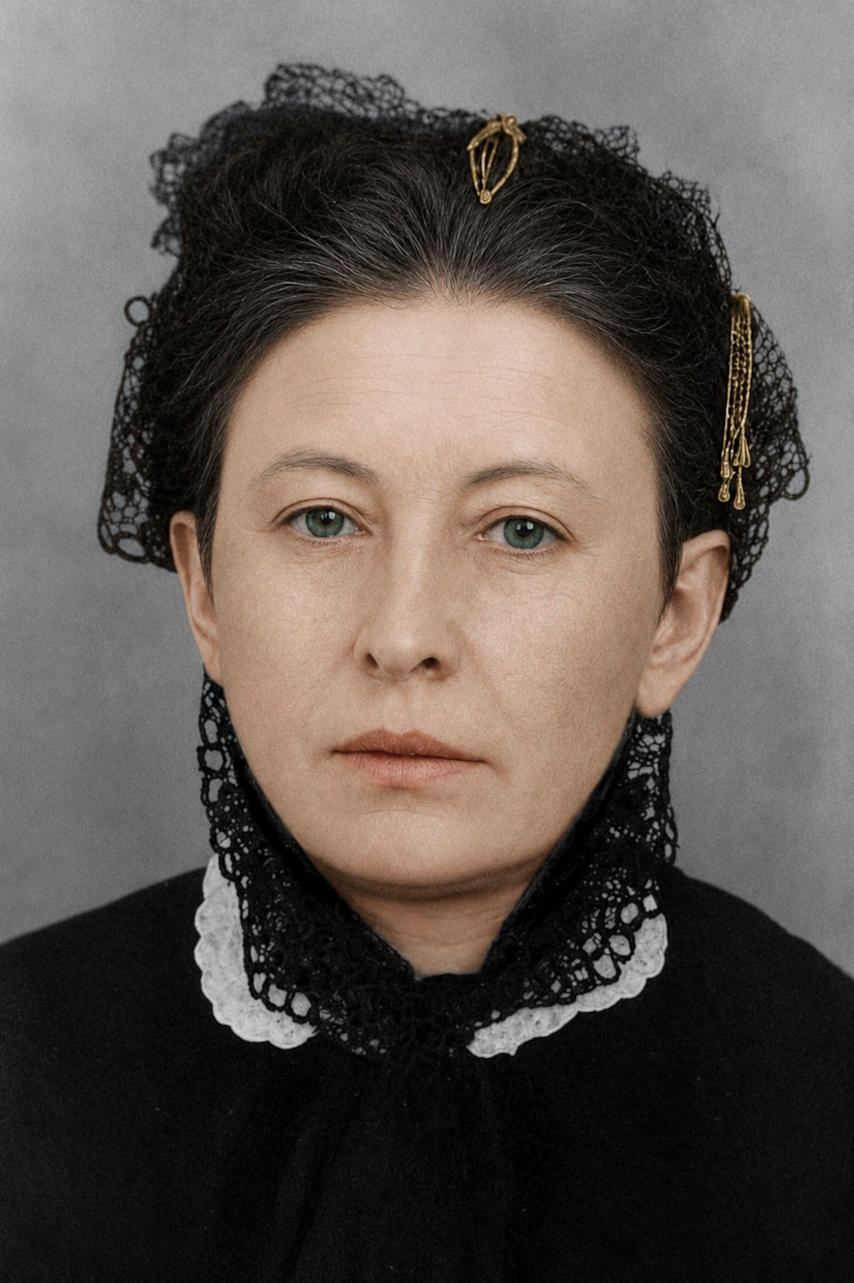
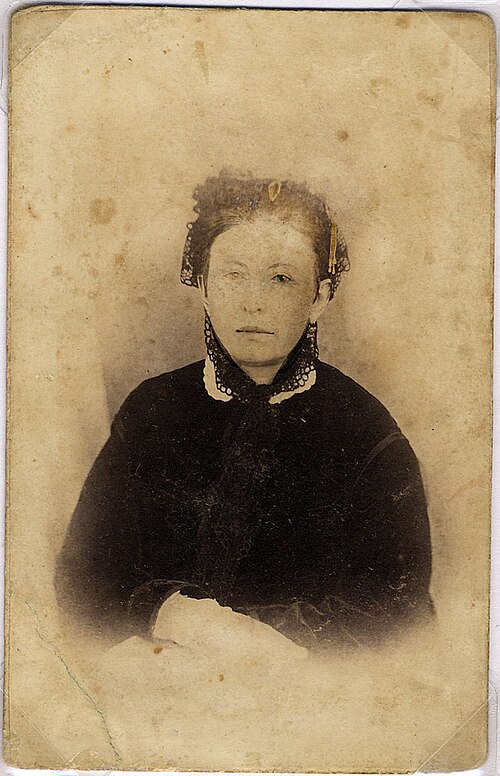
Tsiolkovskaya (Yumasheva) Maria Ivanovna  (1824-1870), mother of Konstantin Eduardovich Tsiolkovsky, circa 1862-1863. Ryazan, Russian Empire. A restored, colorized, and artistically enhanced digital copy of an archival historical photograph from Wikimedia Commons (Public Domain). Digital restoration and colorization by Mykola Krasnostup.

Tsiolkovskaya (Yumasheva) Maria Ivanovna (1824-1870),
mother of Konstantin Eduardovich Tsiolkovsky

File ID: 087

Description: Maria Ivanovna Tsiolkovskaya (née Yumasheva) (1824-1870), mother of K. E. Tsiolkovsky. Ryazan, Russian Empire.

Category: Restored, colorized, and artistically enhanced archival photograph from the public domain..

Source of digital copy of the original black-and-white photograph: Wikimedia Commons (Public Domain)

Digital restoration and colorization : Mykola Krasnostup


Configurator

Image parameters
Educational License
Commercial License
Free Version
JPG; sRGB; 75%;
854 x 1285 px (7.23 x 10.88 cm)
300 dpi
0.15 MB
Free x

Button to download a free image for educational purposes


Terms of Use


Educational License

“Educational License”

This Educational License (“License”) grants the Licensee a non-exclusive right to download the Image from the tsiolkovsky.org website free of charge and to use it solely for non-commercial purposes.

Licensee” means the individual or legal entity that downloaded the Image from the Website under the terms of the Educational License.

The “Image” refers to a historical photograph that has been digitally restored and colorized.

By clicking the “Download” button, the Licensee acknowledges that they have carefully read and agreed to the terms of the Educational License and agrees to abide by the following rules:


The Licensee has the right to:

  • Use the image for personal purposes;
  • Use the image in educational and research works (essays, term papers, theses, dissertations, and scientific publications);
  • Post the image in non-commercial web publications, including social media, blogs, and personal websites;
  • Use the image in educational presentations, lectures, school and museum projects;
  • Store the image on personal devices for the above purposes.


The Licensee has no right to:

  • Using the image for any commercial purposes, including advertising, product and service promotion, product design, paid publications, and revenue-generating projects;
  • Selling, transferring, or distributing the image file or copies thereof to third parties;
  • Publishing the image in paid media or books;
  • Using the image in illegal, offensive, defamatory, or misleading materials;
  • Using the image in logos, trademarks, or branding;
  • Removing or altering the file’s metadata.


Attribution

For each public use of the Image, the Licensee must indicate the following: “Original: Public Domain. Restoration and Colorization: Mykola Krasnostup (tsiolkovsky.org)


Intellectual Property

The original historical photograph is in the public domain. This License applies only to the restoration, enhancement, colorization, and creative processing performed by the Licensor.


Governing Law
This License shall be governed by applicable international copyright and intellectual property laws. The Licensee is solely responsible for ensuring that the image’s use (personality rights) is respected in their jurisdiction.

If you wish to use the image commercially, please purchase a Commercial License for additional benefits.


Thank you for following the Terms of Use!


FAQ


Information icon

Source file as a public domain work

Source of a digital copy of the original black and white photograph: Wikimedia Commons (Public Domain)

Tsiolkovskaya (Yumasheva) Maria Ivanovna  (1824-1870), mother of Konstantin Eduardovich Tsiolkovsky, circa 1862-1863. Ryazan, Russian Empire. Source: Wikimedia Commons (Public Domain).. Public Domain icon

This work was published on territory of the Russian Empire (Russian Republic) except for territories of the Grand Duchy of Finland and Congress Poland before 7 November 1917 and wasn’t re-published for 30 days following initial publications on the territory of Soviet Russia or any other countries.

The Russian Federation (early Soviet Russia, RSFSR) is the historical heir but not legal successor of the Russian Empire, and the Russian Empire was not party to the Berne Convention (it was not country of Union for the protection of the rights of authors in their literary and artistic works), so according to article 5 of the Convention this work has no country of origin except:

  • in the case of cinematographic work the maker of which has his headquarters or his habitual residence in a country of the Union, the country of origin shall be that country,
  • in the case of architecture erected in a country of the Union or other artistic works incorporated in a building or other structure located in a country of the Union, the country of origin shall be that country,
  • in the case of other works if the author is a national of a country of the Union¹, the country of origin shall be that country.

¹ – Author who is not a national of a country of the Union but who has his habitual residence in a country of the Union, be assimilated to national of that country.

This work is in the public domain in the United States because it was published (or registered with the U.S. Copyright Office) before January 1, 1931.

Information iconFeatures of using AI tools in the restoration process

Features of using AI tools in the restoration process

During the restoration and colorization of digital copies of original black-and-white photographs, machine learning technologies and neural network algorithms were used exclusively as one of many image pre-processing tools for the following technical operations:

  • noise and artifact removal;
  • improving scan sharpness and quality;
  • upscaling (increasing resolution);
  • correction and restoration of some damaged areas (technical restoration);
  • basic rough colorization;
  • removal of dust, scratches, and stains;
  • increasing contrast and detail.

The restorer did NOT use machine learning technologies or neural network algorithms for the following technical operations:

  • to modify the face, expression, facial expressions, or anatomy;
  • to generate the background;
  • to recreate lost fragments without manual rework.

The final result is the artistic work of the restorer, who:

  • manually processed the colors;
  • manually corrected the details;
  • manually processed the face and key elements. Minor distortions of small details are possible.

For reference:

AI (artificial intelligence) is a field of computer science that focuses on creating systems and programs capable of performing tasks that require human intelligence.

An AI tool is any application, program, or service that uses artificial intelligence systems to perform tasks faster, more accurately, or more conveniently than conventional tools.

Information icon

Features of colorization of an image that was originally black and white

Colorization is the process of adding color to an image that was originally black and white or colorless.

Colorization makes old historical photographs more realistic and vibrant. However, the colors of objects in black and white photographs cannot be restored with 100% accuracy. We conducted historical and visual research of the materials and colors of all objects in the restored photographs with the goal of proposing historically based materials and colors for colorization. The research was conducted according to the principle of “first direct sources, then contextual analogs, and then careful visual reconstruction.” For each object in the photographs, we checked whether there was a direct description in any sources. If no direct information about the material or color was found, the most probable variant was chosen, consistent with the visible tone in the photograph, the general clothing practices of the time, and the characteristics of old prints. Accordingly, although the process of colorizing the original black-and-white image is carried out based on the historical context, the result is the restorer’s artistic interpretation and does not claim complete historical accuracy of the color scheme.

Information icon

How to obtain an image for non-commercial use?

Click the Download button and download a free ZIP archive containing the image, complete with an “Educational License”.


Keywords:

Tsiolkovskaya Maria Ivanovna , Yumasheva, mother of Konstantin Eduardovich Tsiolkovsky, mother of Konstantin Tsiolkovsky, mother of Tsiolkovsky, Tsiolkovsky, Tsiolkovski, Ziolkowski, Ciołkowski, Tsiolkovskiy, Tsiolkovskii, Tziolkowsky, Ciolkowsky, Public Domain, Commercial license, Educational license, Royalty-free, historical photo, photobank, photostock, restoration, colorization, digital product, download for free, free download,


book2

Do you want to get acquainted with the results of Konstantin Eduardovich Tsiolkovsky’s research?

In the “Scientific Heritage” section of the site you can read some articles by Konstantin Eduardovich Tsiolkovsky translated into English and download them in PDF format for free.

In the “Научное наследие” section of the site you can read most of Konstantin Eduardovich Tsiolkovsky’s works in original Russian and download them for free in PDF format.


Enjoy reading!